A gym encounter and evangelism

I started going to the gym about 20 months ago. This was after a slow realisation that Ph.D. had left me in a relatively poor state. I was obese according to my BMI although nobody commented on me being overweight.  I was also relatively unfit. I came to acknowledge that my lifestyle was largely sedentary and I needed more exercise. One of the things that had scuppered previous exercise routines was that they got disrupted by circumstances. Walking depended quite a bit on the weather and people to go with swimming was cancelled whenever there was a competition in the pool and  yoga was simply too much effort most mornings. Actually, I was intermittently doing yoga but that was really it apart from general walking with life. The ability of Ph.D. to eat time that was available and still be hungry did nothing for my routine. What I needed was something that I could fit around my life and was less likely to be cancelled. That for me meant reluctantly going to the gym. As it turns out gym suits me when it is part of a wider regime.

Now fast forward 16 months and they gym is being refurbished so changing rooms are less comfortable than usual and there is no hiding away in a cubicle. Another girl came in while I was changing for a gym session. I could see my sixteen-month-earlier-self in her and could sense she was nervous. I also suddenly realised I was one of the reasons she was nervous.  You see having been going to the gym regularly for little over a year I looked like a person who went to the gym.  I think I had only just got down to a normal BMI but I was confident in the settings and I as long as I stuck to my routine I knew what I was doing.

Having heard others talk in the gym, I would say that the same is true of most of them. There was a time when they were that new, totally unfit, klutz, trying it out for the first time. Indeed, I suspect many like me still by default think of ourselves that way. It means that the gym goers when they notice a new person (many gym goers are very much working on doing their thing) think not “look at that slob how dare they come here” but “good on you, hope you stick at it”. However, that is not how they are perceived by the new gym goer.

Now this is not an article encouraging people to take up the gym. I could write that but there are plenty out there. Rather it is an article about people who come to church. It is so easy in a church to look at other people and think they have their lives together, that they know what they are doing. This is particularly true of when looking at those who have been at the church for a long time. That is not how many of us see ourselves in the church. We see ourselves as messed up individuals who are struggling to make it up as we go along. We are often focused on our needs and getting those dealt with, just as gym goers are. We are not the super religious that others look up to. This is our perspective.

When people less familiar with the setting come in they do not know this. What they see is, like a new gym attendee, that everyone else is more proficient and able to cope than they are and that includes us. I wonder how much the accusations of “hypocrite”, so often thrown at people who attend church, is not the equivalent of “gym rat” used of those who go regularly to a gym. It comes from a person’s feeling of inadequate and is addressed to those who they as making them feel that and judging them. Whether of not they are in fact being judged is irrelevant, the perception is all.

I cannot say that I got it right, but that time I broke the changing room taboo and spoke with the girl telling her my story. I hope it encouraged her. The questions is how do we let people in the idea that we were all once the newbie with our congregations and we are not always as sure of how things work as they appear.

Groupings – A historic memory of why

There is a lot of hitting out at groupings suggesting that they are causingdecline at present. I have a memory that goes back to the early days of grouping within the URC, and I think it is time to tell the story of why they originated. I am talking of things that happened in my teenage years.

Let’s be clear Congregationalism had a loose form of groupings probably going further back than the 1950s. My father’s first pastorate was “Oundle and Wheeldon” i.e. two separate congregations who had combined resources in order to be able to employ a minister. Equally in my childhood from 1972 my father was the minister for a group of churches. The key characteristic of these groups is that a number of congregations came together to employ a single minister.

In 1976 my Dad stopped being in parish ministry, and we worshipped in an experimental group of churches. That is it had a team of ministers and also a large number of churches. It was a deliberate attempt to go against the then policy which was often to merge small churches together. The statement I remember went along the lines that merge two churches with fifty members and in then years you have a congregations with fifty members. In other words, it was a serious attempt to reduce the decline closure and merger was creating. The argument was that people were motivated to keep their congregation going but were often not motivated to keep the merged congregation going.

They worked at least short term. The group I was part of lasted from the seventies through to the nineties and maybe even into the zeros. Some of those congregations found through various initiatives a lease of life during those years and actually the level of lay leadership increased through those projects. The congregation I was closest associated closed shortly after its social outreach was taken from it. I suspect that if it had remained there may have been another decade of life in the congregation. In other words it worked, it slowed the rate of decline. There is one church (maybe two) in an area of Manchester where under merge and close there would be none.

Now the study was not academic, the ministers who were trying different things to see if they could halt decline were of course the innovative and go ahead ministers. You cannot sort out the quality of the minister from the experiment. It also gives a hint of what might be wrong with the current debate. If a successful minister is one who has a single pastoral charge may it not be that there is a tendency for ministers not to seek group positions if they can get a single pastorate?

Of course, the big problem is not that groups cause decline. The sort of grouping being talked about is what the Methodist have done for centuries and forgive me although Methodism is currently in decline, I would be very reluctant to describe it as that in the middle on 19th Century! So what to make of it.

The problem is that grouping that is often talked of is done without concern for the Ecclesiology of the tradition. The relationship between the minister and the congregation is not the a top-down relationship within the Reformed tradition. Ministers are NOT appointed by Bishops (like the Roman Catholics), General Assembly (like the Methodists)  nor by other ministers. They are appointed by the local Church. The local Church has normally been associated with the local congregation. There is however no reason why it should be a single congregation. Could not a local Church consist of a number of worshipping communities serving different  constituencies within a wider community? These constituencies could be defined by place, age, theology, worship style preference or missional service. The one thing they would need to agree on is an Ecclesial structure (or how they interact formally with each other)

A grouping of local congregations under a central-governing body is not something new within the Reformed tradition.  This is what seems to have happened with the Geneva Consistory. It needs to be noted the consistory did not belong to one congregation but to the whole of Geneva and had responsibility for discipline of ministers among other concerns.  It was however primarily made up of lay people with the chair being the senior minister and as far as I can tell no other ministerial representation. Ministers were given responsibility for specific congregations or missional work by the Consistory.

I do not think this will be popular with anyone, but I do think that it highlights what is theoretically missing in the current discussion. That is a coherent thinking on the relationship between congregation and minister. At present I see the talk of grouping and the resistance to it being a discussion about power. If the local congregation can retain the power to appoint a minister then the members understand their connection to the minister. If, however, groups are created with minister or synod appointing other ministers then we become a denomination ruled by ministers.  Unfortunately that model, I can see members deciding that the denomination has lost interest in them so there is no reason to belong.

You May be United Reformed If

  • You think the right colour to paint a church is blue
  • Your Church sells Marmalade to raise money
  • Your Church has a walking group
  • On receiving an important document you first proof read it
  • You regularly make soup in large quantities
  • Psalm 23 is ok but nothing compared with the Scottish Psalters version of Psalm 24 or Isaac Watts version of Psalm 122 it really is just another psalm
  • The right tune to any hymn is that which is sung by your own congregation
  • You put your hymnbook down to sing “When I survey..”
  • Having candles in church is heatedly debated on the grounds of fire risk

I will add as I think of fresh ones

A Doctor in the Church?

There has been a blog discussed on facebook suggesting that it might be a good idea for congregations to employ theologians. The blog was taken down, but I did find this article on Christian Century describing Theologians in Residence. Now before we go any further let me be clear I have a vested interest. I am a lay person just about to complete my doctoral studies in theology. So it looks as if the church is about to create positions for people like me. O this is America so it may come about in the UK about the time I am due to retire, so I am not holding my breath.

However I want to question the whole idea, but not for the usual arguments. The usual two are as follows. Firstly that all Christians (Muslims, Jews and Atheist as well) are theologians. That is they have a conceptual frame work that works around the idea of God (even if in the case of most* Atheists this is God’s non-existence).  I am quite happy with that, I would encourage such people to work at and thus clarify their understanding as much as possible. Trying to speak honestly about the nature of God is in my opinion a good thing. The second is that the cleric/minister/priest is a theologian in residence, and to an extent they are right. That is the cleric/minister/priest will have spent time in theological education, should have an understanding of the wider debates within Christianity and has a role in helping members of the local church grow in their understanding as well as action, character and devotion to the faith.

However “the Theologian” is not new, not within Reformed circles, it goes right back to at least John Calvin. His five fold ministry was Apostles, Prophet, Minister, Doctor and Elder (yes no Deacon although the role is explained in the Institutes).  What I am interested in is the office called “Doctor”. This is what I take a theologian of the Church to be. One thing should be immediately clear, those offices are in order of seniority, “Doctor” is lower than “Minister”. You technically would expect to be more of them, but there have been fewer recognised. Oddly enough it never go to none but you needed to listen carefully to discover who is Doctor and not a Minister. They also tended to fill roles that looked senior to ministers such as being involved in ministerial training.

Apostles and Prophets arise in time of crisis; the Apostles providing leadership and the Prophets warnings. However on a day to day basis they are not needed. He however then folds them back so that Ministers are the common place equivalent of Apostles and Doctors are thus common or garden prophets. Lets look at the two senior roles in ancient Israel Priest and Prophet. The Apostle would map to priest roughly. In one important aspect at least, the priest was entitled to income for his religious role. This is acknowledged for ministers. The snag for this is that the prophet isn’t. If a prophet was a priest then he did get the income as a priest to enable him to fulfil that role but he did not get it for being a prophet. The prophet needed independency to fulfil their role as prophet in ancient Israel. The doctor/theologian needs independency to fulfil their role in the church and the congregation needs an independency from them. A theologian is only as good as the insights that they bring.

So no a theologian in residency is not the way to go. In fact in some ways if a theologian takes such a post then they are compromising their role. They become over reliant on the hand that feeds them and can end up saying what it wants them to say rather than struggling with the word of God.

Remember I said that Doctors of the church should be more numerous than ministers, but few are recognised. They are there, indeed they exist already in every congregation in my experience. They quite possibly have done some extra study, fulfil teaching roles e.g. lay preacher, head of junior church and are known in the congregation for their deep spirituality. They probably make up the core members of your bible study groups. They may or may not be elders and not all elders are Doctors of the Church. Some ministers are, and some are not; just as some priests were prophets and some were not.

*I am aware that there are individuals who would use the badge Atheist, but do not make such a clear statement.

The Positively Attentional Living

I have not written for ages on this blog. I simply have been too full with my thesis but something has started bugging me and I think it is time I put it up. I have been reading quite a few Puritan writers on or off over the last couple of years and I am beginning to unearth a spiritual practice I think has been lost. We know of the Roman Catholic practice of confession, with its effort to note the sins in one lives, confess them to a confessor and then through repentance move on from them. It is also known Puritans quite often went in for a detailed examination of their lives that echoed this. What has not been asked is how the Puritans understood it. The Puritans seem to have turned the emphasis around 180 degrees.

Lets start one step back. There are many sets of techniques for assuring oneself of ones salvation. You may have come across the sinners prayer, or the conversion testimony if you have had contact with Evangelicals. You might equally find people who are concerned that their belief system matches as closely as possibly that of orthodox Christianity. Equally the more sacramental can be concerned about receiving communion and baptism. I am not suggesting one of these is right and others wrong, they are all partial. That is they grasp part of the truth about Salvation but not the whole. What the Puritans had was another such technique. It relied on the classical Reformed doctrine of Sanctification. The idea being that this was the ongoing work of the Holy Spirit in the believers life. The close examination was therefore not to detect sin and repent of it, but to detect the activity of the Holy Spirit and thus to rejoice at this assurance of salvation and also to help it bear fruit.

Now there is a lot to be said for this as one of the techniques. Firstly it points people towards the positive in their lives rather than the negative. Concentrating on the positive gives people energy. Secondly it changes our perspective of sin. While sin is not to be welcomed, awareness of it and repentance are; as these are signs of the work of the Holy Spirit, convicting us and healing us. I am not sure how to put it into practicebut there does seem something good about watching for where the Holy Spirit is working in our lives and those around us.

Pacifist tendencies but…..

I do not call myself a pacifist, my great grandfather was a pacifist, he would rather be beaten and his family’s income stolen than actual defend himself. That takes guts and strength of will. I am not saying I do not have it, but I do not feel that until there you genuinely know your will. So I would say I have pacifist tendencies, but they have never been tested when it counts.

However, when I hear stories such as American Soldiers on Food Stamps  I find myself getting angry. While that anger comes out of my pacifist tendencies, it is not an anger at the soldiers. It is anger at the hypocrisy of a society that can applaud men one minute and yet once they are demobbed will leave them to their plight. The world has not changed much since Rudyard Kipling wrote Tommy.

So let me say this now. I believe it is wrong for a country to ask young men and women to do the tasks that they ask people in the army, navy and airforce. I  believe that war is best avoided because of what it will cost and often than cost is born by the most vulnerable. This is not an argument against nuclear war, the number of children who die in conventional warfare is high. Some of the deeds done are horrendous. The US authorised the bombing of maternity hospitals in Africa twenty years ago so that the regime could not provide better facilities for women than had happened under British colonialism because it was communist. Do not worry the English invented concentration camps during the Boer War. War leads all nations to behave in vile ways.

However, it is one thing that says that war is not something we should plan for. It is another thing altogether to hold the soldiers who serve as responsible for these vile things they are ordered to do in our name. In many ways, they are as much a victim of war as the children who get killed by a stray bullet. We ask of them what we could not do ourselves, what we are not prepared to do ourselves. In the process of doing so, many come back with injuries both physical and mental that makes integrating into normal civilian life difficult. Indeed there is a sense in which the military, having its own code of behaviour, can institutionalise soldiers and make their return to civilian life difficult even without a disability.

Now if we ask people to do this. I know the government does, not me personally, but the government does on our behalf. Then I see as a basic quid pro quo, that we have a responsibility to look after them. In other words, when a young person signs up to join the services the nation takes responsibility for making sure they are cared for, not just while they serve, but for their life. Often that also includes responsibility for the family as well.

So I will not be there out cheering on the soldiers on parade, may well campaign against various wars and choose not to wear a red poppy. However, I will not be among those who berate soldiers, I will donate to charities that aim to look after them, and if ever there comes the opportunity to vote for better conditions for ex-servicemen and women, they can count on my vote.

I would rather they were not asked to serve, but given that they are, it is the least we can do.

How Green are the Reformed?

I can remember when I was seventeen giving a brief talk on the pros and cons of nuclear power which was largely informed by information provided by Friends of the Earth. I was not a member of Friends of the Earth but the information had been given by a friend of the family and I read it and digested it. It was a hot green issue in those days and friend was a URC member.

Yet if you had asked me five years ago what was new in the URC I would have said a concern around green issues. This has been slowly but surely climbing up the agenda both in terms of personal behaviour (how often do you share lifts, recycle paper, tins and plastic or participate in other green initiative) and nationally within the denomination.

I suppose I was accepting the obvious, the way the Reformed tradition is credited with being an activist tradition. That is we are an industrious people. To give you some idea look at what the Scots did in “Wha’s like us” but then it was English who largely made up the New England Puritans, which were the driving force in the US as well as a good few industries England. It is hardly surprising being good bible readers we have taken perhaps too literally Genesis 1:28  “And God blessed them, and God said unto them, Be fruitful, and multiply, and replenish the earth, and subdue it: and have dominion over the fish of the sea, and over the fowl of the air, and over every living thing that moveth upon the earth”(KJV).

Yet the more I look into it the more there seems to have been an undercurrent of ecological sensitivity. It is John Calvin who talks of world as “theatre of God’s creation” and Jonathan Edwards (17th Century New England Congregational Minister famous for his Hell fire sermons) who had a sense of rapture in the surrounding countryside. It looked rather as if it was something we had lost and rediscovered in this century. Then however T A Leonard with his walking holidays came along for the late nineteenth early twentieth century. I think it is safer to assume it has always been there.

So when Iona Community is seen as having Celtic Spirituality or the fact that perhaps the first book on the Green character of God was “God is Green” by Ian Bradley a Church of Scotland minister back in 1992 is not that surprising. They are giving voice to a secondary discourse that has run almost as a stream underground within the Reformed tradition.

Why I post pro-refugee, pro-immigration and pro-muliculturalism stuff to Facebook

A while ago a friend posted some anti-asylum stuff to Facebook. Typical right wing hyperbole, the thing was this friend should have known better. The church she goes to supports Sheffield’s City of Sanctuary. It was fairly easy to counteract the stuff from the governments own sources! She responded with “at least now we can talk about it”.

Well reporting this sort of stuff is not a good idea, arguing nearly always forces people into a more extreme position than they held before. I have known few people rethink positions in arguments unless they started the discussion in an attempt to rethink. So I decided to disengage. I could I suppose have deleted the post from my Facebook stream.

The problem was not that people held it but that I knew she was in contact with a number of people who held much stronger views than me on this and she had not picked it up. So I started to think about it. I decided it was time I put a marker.

Firstly I did not really want to join a campaign, there were plenty very worthwhile ones but I felt that campaigns are often over strident and I wanted to take the pressure off people. I also decided that putting out a lot of statistics and legal stuff was not going to get me anywhere.

Secondly I decided that what I needed to do was to encourage people to see asylum seekers, refugees and immigrants as fellow human beings. That meant seeking out the human interest stories, the people who relate their experience with individuals who can make the day to day reality come to life in this country.

Thirdly my task was to try and get people to think and not to tell them what to do. Doing this meant that I needed to limit the amount of stuff I put on Facebook stream. There is lots of stuff out there, but I wanted not to become a person who only talks about one topic. There had to be other topics in discussion and these had to be non campaign as well. Only when this was part of the mix on my stream would it be effective. This is also why I will post when I sign a petition but I am not going to say to other to do it as well. It is up to you.

I do not know how long I will keep it up, but I do want to try and do it for quite a while.

The Reformed Look

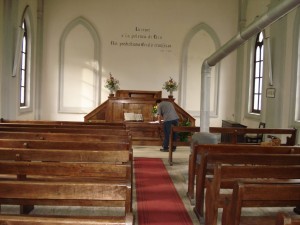
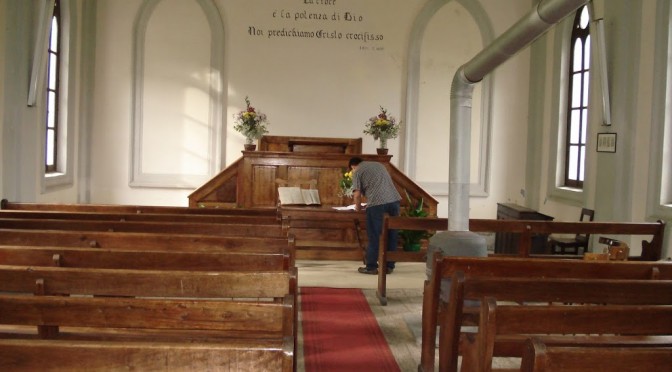
This church should feel very familiar to many people in the URC; the plain wood, the clear glass the white washed walls, and the communion table at the centre in the front with a pulpit above and the Bible open. If it was not for the red carpet you’d almost be sure you were in a URC.

However look closer and you see the heating systems a bit different to what we are used and there is writing on the wall which is not in English. You are actually looking at a Waldensian Church in the Alps in Italy. If you click on the link it should take you to a webpage that tells you more about the Waldensians. However it is enough to say they are the Italian branch of the Reformed family of churches.
 
Some of the more ornate traditions within the faith look at us and see cheapness, they are of course wrong. The chairs and furnishings may be plain wood but they high quality oak, the windows may let through plenty of light but if you look carefully you see they are not plain glass, the drape across the door may not be spectacularly embroidered but is of heaviest quality velvet. This is not cheapness but a deliberate aesthetic and the quality of the goods use belies their plainness.

I have heard a number of theories, some suggest it is iconoclasm, if that is the case it is to Zwingli in Zurich it comes from not Calvin in Geneva, for whom candles and such were irrelevancy. It might have been a reaction against those who would enforce ritual upon us that we chose to be plain just to contrary, or perhaps as in many places the early churches were barns we have chosen to remember those times by keeping as similar sort of aesthetic. I suspect it is kept today largely because to us it feels right.

In what is often a light calm space comes a specific arrangement of items. At the focus is the communion table and not the cross (empty or otherwise) which puts our action in the context of a God who choose to connect with us. In quite a few churches although the communion table is the focal point the congregation is arranged so that we see each other emphasising the communal nature of worship. The lectern and pulpit are also prominent at the front, sometimes above the communion table, sometimes to the side to remind us visually of the importance of the Word. The lack of paintings and other artwork has not made the space lacking symbols but one where distractions are eliminated to allow the central symbols a more clear space in which to speak. It encourages us to pay attention to these things.

A Restless People

Firstly I have reached a bit of an impasse. I seem to be totally confused about what has been put into my local congregations Newsletter. So what I am going to do is keep posting them to the editor when finished and putting up Monthly one here, but the order will not be the same as in the Magazine. Now onto this month’s piece

It is one of the oft forgotten things that John Calvin was a refugee in Geneva to the day he died, he never took Genevan citizenship. In fact Geneva at the time had a large émigré population of Protestants from France, as well as attracting others from as far away as Scotland.  It was also a faction ridden city, not really a comfortable place to settle. John Calvin is therefore unique amongst the Reformers in not serving within his own homeland but always as an alien.

This odd coincidence has become a repeated pattern of travel and dislocation within the Reformed tradition.  There are the Pilgrim Fathers, who travelled from North East Lincolnshire to Holland, then back to the UK and onto found Plymouth Colony in what is now the United States. Gainsborough URC claims direct descent from the congregation that they belonged to. The Waldensians travelled from their valleys in Northern Italy to Geneva to escape persecution in the seventeenth century. The five mile act making people walk five miles from their homes to worship. John Bunyan’s work, Pilgrim’s Progress was very much a creation of those days. More recently, the continual moving across the Scottish border of more fervent Presbyterians, which supported the former Presbyterian churches in what is now Northern Synod and then the Industrial revolution pulling Scots south into England to provide the management for the factories. The burning bush is the start of the story of the Exodus. Reformed Christians seem to be on the move whether voluntarily, force  or in the imagination.

This seems to have entered our psyche in the URC we even imagine our buildings as connected with travel. Some think of the church building as a meeting tent that moves with the congregation; if the congregation moves, then you need a new building where they now are. Or perhaps it is a caravanserai, a place where people who are travelling, could come together from their wanderings, a place of relative safety and companionship with other travellers.  It is hardly surprising we often struggle with being a local church, somehow we are never quite at home rather we echo the writer to the Hebrews:

For here we have no lasting city, but we are looking for the city that is to come. 
(Hebrews 13:14)