
Reformed Democratic Pneumatology

I started this a while ago, but with the Church of England debate and the increased discussion on how church councils should be conducted. What I am doing is outlining what I see as the important balance within the theology of discernment carried out in councils of the church from the English Reformed Perspective and the disciplines that are needed by members for that to function.

Firstly let me say that URC like the Anglicans have a lot of procedures which on the surface appear to be democratic but can often lead to things that people do not see as democratic outcomes. The grumbles within the URC tend to focus particularly on the ability of the major councils (General Assembly and Synod) to engage with the local congregations. Like the Anglican church they are often seen as the provenance of the self selecting few.

Long words I am afraid, but I think this needs to be said as the URC is going once again through the “we are governed by the people” “no we are not we are governed by the Holy Spirit”. The correct answer it of course “Yes”, it is not an either or situation. Firstly there are some quite specific things that English Reformed Church has adopted:

  1. The belief that the Holy Spirit can and does speak to who the Holy Spirit chooses to speak, not to who we say she should speak with.
  2. That the Holy Spirit diverse in its revelation,that fits with the need of the person
  3. That the Holy Spirit speaks into the context into which it is sort and what applies in one context is not what necessarily applies in another.

There are however some things that equally need to be stated:

  1. We have never assumed that all people speak with the same level of guidance. There are those within every congregation who have a track record of being open to the leadings of the Spirit and these carry more weight.
  2. That the discernment of the Spirit is a communal act that requires that people who participate in the discernment are present.
  3. That the tradition of the Church is a good tool to be used within the discernment of the Spirit. Thus those who are learned in the faith carry the extra responsibility in discernment and may be called onto advise.

This is important, because the councils of the church are not exercises in democracy but exercises in discernment in which voting is often used. Votes are restricted usually to members, present and although normally a simple majority suffices that is not the always the case. You need to be present not because of some inability to read or ascertain postal votes but because you need to listen to the debate, for what the Spirit is saying through it and also to sense the mood, well what others feel the Spirit is saying.

There is a problem, we all are very well aware of the debate and voting meeting of a secular business meeting and to an outsider that is what the form of our meetings take.

I am going to suggest we need to think about how we conduct meetings and the disciplines with which we conduct them. I am not going to suggest major constitutional changes.

First of all we need at all meetings at all times to practice hospitality. No I do not mean provide food, I mean the practices that make a good host. One is to try an anticipate the needs of others, these can be simple as using a loop system so those who struggle with hearing can hear. That however means every person who speaks in a meeting must speak with a microphone. Therefore if somebody can not easily get to a microphone you need to find ways of getting to the microphone to them. It means that we should all be patient with those who struggle with words and we should all be careful not to bore others.

However I also note that often people when they want a council to change want it to change in ways that would favour them. Everyone is different and therefore have different preferences over how the meeting should be run.  Not everyone is happy standing up and speaking in a meeting. Not everyone is happy working in small groups and feeding back. Not everyone likes to write up on notice boards. Some individuals like silence to think things through others like the cut and thrust of a debate. Some people like formal approaches others prefer informality. Some like to have information in advance and will read and digest it, others much prefer that everything is presented at the meeting. Some like the routine to be the same each time and some find variety to be more engaging. As we choose approaches so we also choose the people who are most likely to contribute. There is no easy solution but we need to be aware that the way we ask people to participate alters who is comfy participating.  God has not given a standard form that must be followed but we do need to be aware if people are feeling that uncomfortable that they are self excluding from the debate. In such situations ways do need to be sort to include them without excluding others.

Another important guideline is to keep procedures simple. That is that most people will be more content and feel more happy about contributing if they know what is going on. Having complicated methods of voting and such just makes most people insecure and edgy. Also realise that people often like to suss out how something works before they try using it. Some people will always be flustered if asked to do something for the first time. If you must have complex ways of doing things then make sure that you find at least three different ways of presenting it so people have a good chance to get hold of what is happening. That does not mean three contradictory sets of instructions. It does mean something like:

  1. A written explanation given in advance that people can read and digest at leisure. Most won’t but some people will and some of those who will are highly resistant to something being put on them at the meeting.
  2. A clear verbal re-iteration of what was in the written explanation at the meeting. This is to catch the 90% who just glanced at the paper and have not taken it in
  3. Either a video of people enacting the procedure or a trial run with a pretend issue which can be taken.

If two and three take together longer than five minutes your procedure is too complicated! Equally if people start asking a lot of questions the procedure is too complicated. It may well be better to go for a simpler form. Meeting size matters, as a rule the bigger the meeting the simpler the procedures need to be. In a group of three, it is quite easy to brainstorm, talk things through, negotiate and come to a complicated consensus. Try doing it with several hundred and you will spend several days discussing the date of the next church fair as each checks their diary.

The final one is that we should spend time and energy encouraging people to listen. The real skill of participating in a church council is not speaking but in listening, in hearing not just what is said on the surface but what is also being said below the surface. In some sense this is listening for the spirit, but it is also listening to your inner voice, seeing the way that you interpret what someone else says. Are there words you hear particularly well and also words you miss? Does it matter who says something? It is not easy to listen at that depth, I am not claiming that I do it all the time, but if we are truly to do the discernment it is what is needed. It is easier to listen at this level in a small meeting than a large one. Perhaps a good reason for having smaller meeting in which people can practice doing this. Without those among us who listen at this level we are not really in a position to weigh the material and to progress the discernment. This of course slows things down and in our quick fix society this listening is counter cultural.

Given this as you might expect I do not see form as an essential for discernment, we are human all human form will fall short of the divine, God still works through it. Nor do I think we should expect the outcome to be the same regardless of situation. Because it is not a voting democracy but an act of discernment, I am quite happy with restricting the meeting to those present, with votes that are not simple majorities and with consensus procedures if used appropriately. Votes are in the end only as binding as we make them in this procedure.

If I am honest I think the one essential is that we stop assuming that members will just pick things up as they go along and start actively trying to engage members in doing this sort of discernment and understanding what they are doing in church councils is this. That may require changes in approach, teaching within and outside of church councils and also a lot of careful chairing. It certainly will not make councils quicker initially but I suspect that until we do, people will continue to gripe about them.
    Sing a New Song unto the Lord

    In Prayer and Praises, Nathaneal Micklem frequently uses a hymn as part of the ritual of private devotion. In so doing he is following a long line of Reformed practice. John Calvin made the translation of the psalms into metrical verse not just for public worship but for private devotion. There is a scene in Thomas Hardy where at the end of the day workers down tools and sing together a hymn or psalm. Erik Routley wrote a number of devotional commentaries on a variety of hymn. Songs sung in public worship also used for private devotion seems to be the norm within the Reformed tradition.

    It may be St Augustine of Hippo  who said “He who sings prays twice” but the Reformed tradition seems to have built a whole way of being a Christian around the singing of psalms and hymns. There is something that resonates deep with Presbyterian about “Ye Gates lift up your heads” as I have found since I came to St Andrews, and have you noticed your Congregational friends often put down their hymn book to sing “When I survey the wondrous cross”. These hymn/psalm becomes part of who we are.

    Then hymns speak at different levels not just the words that you sing, many people recall the hymns sung at a parent’s funeral or on their wedding day. However lots of little events equally shape our understanding of a hymn, I cannot think of “Glorious things of thee are spoken Zion city of our God” without also recalling my child hood church of Zion Wakefield, equally “We are marching in the light of God” always recalls singing it while walking around St George’s Jerusalem with a pilgrimage group.

    It is often said that in the old hymns you sang theology but this is too simple. For the last rather two hundred years hymnody has been split into two strands, one appealing more to the head, the other more to heart. The mission hall hymn “What a friend we have in Jesus” by Joseph Scrivens is very much a heart song and yet I can recall as a child hearing my Grandmother sing it. The well formed Christian needs both.

    I sometimes find myself humming a hymn while I am doing something else. The range is enormous, from “All people that on Earth do dwell” through Brian Wren’s “Great God, your love has called us here” and onto “When I was lost you came and rescued me” by Kate and Miles Simmonds a modern Charismatic worship song. However if I stop the hymn I am humming often captures something of my mood that I need to, in the words of the old hymn, “take it to the Lord in prayer”.

    Out of Our Control

    A blog “Growing Green Patches” blogs about her daughters attitude to Storm Sandy and I am struck by the familiarity of the situation. The thing is her daughter who is staying near New York is unconcerned about it, while she several thousand miles away is very concerned. Many will say as she implies that this is just a mothers reaction but I want to suggest something more is going on.

    I have been there, the first time I recall this was during fuel shortages during the Winter of Discontent. Our relatives in South Africa had us all frozen to death in our beds, in actual fact, my sister and I were enjoying extra days holidays from school and every time the fuel tank seemed to be on the point of running out Dad tipped it up slightly more so as to allow the oil to flow towards the outlet which was not at the lowest point of the tank.

    My fathers explanation at the time was newspaper hype, but thinking back, about Storm Sandy and other occasions I do not believe that. There is as much hype where we are as anywhere else.

    Then there are my experiences of stalking. The first I was involved in it was not me being stalked! I can remember being very worried about my friend who was being stalked. I can only put some of that down to the fact that I knew I was really out of the situation and did not know what was going on and could not influence it. Equally some years later I ended up with a minor stalker. I would not class it as in the same category as the previous one but this time it was me being stalked. Oddly enough it was not until others began to pick up on this that I realised that people were actually worried about what was happening. I felt no personal threat at all. The thing was I knew what was going on, I had at least some ability to determine what was going on and yes some of that was to ask for help.

    So what is happening in these situations. The person involved is nearly always well aware about what is going on. They are making rational decisions on what to do in the situation and then getting on with life. Oddly this provides a cushion from the over active imagination when you start thinking about what might happen. Participating actually makes you more able to cope with things. Those outside the situation are unable to see the elements of choice within it and their dire imagination takes hold.

    Or take my parents my mum has mild dementia, nothing unusual in that know that before she showed signs of developing it both my parents thought dementia was one of the worst things that could happen to a person. Now they are living with it and adapting to it. Again the perspective of being directly involved seems to make the whole thing less difficult, probably because both my Mum and Dad are finding ways to adapt and tackle it.

    Come to think of it, I can see this pattern in a lot of situations. When we imaginatively think our selves into a situation we tend to concentrate on what is being done to an individual and not consider the individuals experience of agency. The response is then a largely emotional one, while for those in a situation the response is often at least in part rational  (ask now what do I do, weighing up the options and responding).

    I do not think this is quite normalising things. People know the situation is abnormal yet theie agency within it enables a far more pragmatic approach than those outside of it.

    Speaking amongst other Voices

    The Reformed tradition seems to always be multi-voiced. The idea of mono-vocal or multi-voiced discourses comes from the work of Mikhail Bakhtin a Russian philosopher, better known for his work on Carnival. Multi-voiced discourses are where even if only one person is speaking you can hear echoes of previous utterances by other people. Sometimes this make a cohesive voice, like a large choir all singing the melody, and sometimes they produce a polyphone of harmonising and clashing themes. The Reformed tradition appears to be one of the later.

    This leads to always having a “yes but” stance which is uncomfortable. In part I think this discomfort may explain some of the Reformed tendency to splinter into smaller groups Scottish Presbyterians clearly who have this propensity, but Congregationalism just tended to do it more often with smaller numbers. Thus divisions do not appear denominational level. The aim of division was to reduce the divergent voices and thus make a more comfortable position.

    This ignores the flip side, which is actually older, the tendency to seek merger and unity. If there is a single action that creates the Reformed tradition then it is the signing of the Tigurinus Consensus in 1548 between John Calvin and Heinrich Bullinger,Huldrych Zwingli’s successor in Zurich. The first cross tradition merger was between Cavlinist and Zwinglites which created the tradition.  Now the theologies of the Calvin and Zwingli are different, but there was enough common ground that they were able to acknowledge each other as part of the Church merger creates multivoicedness.

    Thus Ecumenics is not a twentieth century phenomena, but finds its echoes in leaders with a Reformed heritage of such as George Macleod, Brother Roger of Taize and Tullio Vinnay (founder of Agape a centre for reconciliation in the Italian Alps) . What was new in Twentieth century was people looking beyond the wider Reformed tradition.

    So if we were not splitting apart then we were coming together! There are lots of people who through time have spoken from what they perceive as a Reformed position. Some have wished to take the high ground “only if you believe this are you properly Reformed”, others have wished rather to build on common ground just as John Calvin did. The challenge is to find ways of speaking within the multitude of voices.

    It may appeal to be silent, but a choir where everyone is silent is not singing in harmony, nor is it really a performance of a choir piece if only the soloist sing. So we need to find ways of speaking about what we believe. However if we are to create harmony and not discord we also need to learn to listen to other people, not necessarily to sing their tune, but see if we can’t adjust ours so that it compliments rather than clashes.

    God will protect

    I am struggling with something and I am well aware that if I were to post my response by the posts that are there people will think it uncaring. However today a second source got me thinking more widely and I think I need to put this down before I forget.

    I follow the devotions from Peachtree Presbyterian Church largely because the pastor Mark Crumpler seems to be on a similar wavelength to me and his thoughts are often enough worth hearing. Today he began with

    And we know . . . all things work together for good (Romans 8:28)

    Now the simple reading of this is nothing bad will happen to Christians, and if you ask for God’s protection he will give it. It is of  course from Chapter 8 a chapter with more than its fair share of Paul’s purple prose (excuse the alliteration). Between that an assuring us that nothing can separate us from the love of God you’d think it was a rosy picture but…

    this is also the chapter where Paul says

    For I consider that the sufferings of this present time are not worth comparing with the glory that is to be revealed to us. (vs 18)

    and

    As it is written,
    “For your sake we are being killed all the day long;
    we are regarded as sheep to be slaughtered.” (vs 36)

     
    Even the nice verses sometimes have a sting in them:
    and if children, then heirs—heirs of God and fellow heirs with Christ, provided we suffer with him in order that we may also be glorified with him.(v17)
    The bold is mine but I think it is getting to the core thing. I am not really sure how effect praying for protection from life’s ills is going to be when you are dealing with a god who got himself crucified! Somehow I do not think the protection from life’s ills are exactly a high priority with God. So although I will happily pray “Lead us not into the time of trial” I am not at all sure that life is going to work out, or even that “time of trial” means times when bad things happen. I have my strong suspicion he meant something else when he told us to pray that, that the troubles of this life although unpleasant weren’t exactly the trials he thought we should be asking to avoid. I think in some ways God is interested more in the bigger picture and how we fit within that.

    Let me be clear the bringing out of wider purpose out of personal ill has been part of my life. Over fifteen years ago I was betrayed by someone I was in an intimate relationship with. I am not going into details, partly because I do not wish to but also because there is a sense in which I can ever only partly tell the story as big chunks are missing and I have to ability to find discover what should be in those chunks and none of the surmises really work. It left me in a state where I felt insecure in my own home and I could count on the fingers of one hand the people I actually trusted. It has left me with scars, most do not appear on the surface but scratch deeper and you will find that nothing is quite as it appears.

    However it always resulted in me doing two things: firstly I needed to find a way to be able to cope with a world that I knew was largely socially created and that I could never be certain it was as I assumed it was; secondly I had spare time, did not want to invest in new relationships so went on a church study course instead. The study course eventually led to me taking first a masters and then my doctorate; the need to find new ways of understanding led me to an openness to Postmodernist theorists that I would not have had otherwise. Both of these have shaped my thinking for my thesis in many ways. If the betrayal had not happened I would not be writing the thesis I now am, I might well not even be doing a thesis.

    So that I have seen but these are endings which tell of the bigger picture. Let me go back to todays devotion, it centres around Naomi, and her return to Canaan. She returns having lost her husband and both sons with Ruth. This is disaster and yet she is returning to family. Of course the story ends happily with Ruth marrying Boaz and becoming the grandmother of King David but let us not forget almost certainly Naomi never saw David, when she died she only knew of the security Boaz gave her and Ruth. She never experienced the bigger picture, the story God was involved with in all its glory.

    So I am not going to be nice and pretend that if we accept God’s will we will personally see the reason for the hurt and suffering. I will say God can and does work through them but how or why I am not sure. Remember Christ’s prayer in the Garden of Gethsemane is not just that the cup of suffering would pass him by, but that in the end his father’s will will be done and that meant that it did not pass him by.  Thus the prayer to take up our cross and follow Christ is a prayer to accept the suffering that will come and to still follow God. It is not easy, I suspect in part that is why so many of the psalms are angry with God but it does seem to be God’s way.

    Talking About Practical Piety

    As part of my Ph D thesis I am having to write about the Reformed tradition, not as a theological tradition but as a social phenomenon. It is a challenge, there is a large quantity of work on Reformed Theology, there are some books on how to be a good church member and some that try to make the Reformed tradition a spiritual tradition in much the same way that Ignatian Spirituality is. None of these address the real question I am asking which is something like; “How does it differ in the day to day living to be a Reformed Christian rather than any other sort of Christian?”

    I have chosen to call this ‘Living out the faith’ a piety. Therefore a piety lies somewhere between a morality in the broad sense of how do you make moral decisions in your life and a spirituality that explores how you understand yourself as relating to God. Everyone’s understanding will be different; there is nothing wrong with this; well at least for the Reformed there is nothing wrong with this. This is just my understanding.


    I have chosen to call it practical. I think that “practical” is a better term than David Cornick’s choice of “worldly” but I believe we mean similar things. We expect a piety driven by faith to make a difference in the world not just for us as individual but those around and the wider community. In my thesis, I do not use “practical” in the title of the chapter, but I will have to have a section on why I think it is practical or worldly. Maybe the cultural aspect that Max Weber was trying to describe as the “Protestant work ethic” is far more closely allied to this very down to pragmatic approach to faith, than to a Lutheran doctrine but whether either relates to capitalism is anybody’s guess.

    However that is for my thesis and I do not think that most of you will want to read my thesis chapter at this stage. Possibly you will wish to see the final version. Rather what I am doing here is to try and write a series of short articles on aspects of practical piety from a Reformed perspective that are aimed at those who are generally  interested rather than academic sociologists.

    [Next Blog not until 1st October]

    Standards, we have got to have Standards

    All right the title is jokey, the thing is the Reformed tradition has subordinate standards. Now don’t go looking in the Westminster Confession, or Belgic or the Statement of Nature, Faith and Order of the United Reformed Church for statements about Subordinate Standards, you won’t find any. The simple reason is this is self referential these are the subordinate standards. That means for all URCs that the principle Subordinate Standard for us is the Statement of Nature, Faith and Order of the United Reformed Church. So saying we don’t have standards is a bit stupid!

    There is one thing every one should spot I have so far and will continue to do so, use the term Subordinate Standards. They are Subordinate to scripture. The Protestant shout of “Sola Scriptura” means that practically they never ever have been the final statement on the faith. Doctrine can and is Reformed in order to bring it better in line with Scripture. This is alive and kicking in Reformed Churches. I can remember being asked how a hymn of Kathy Galloways could get into Church of Scotland hymn book where it would struggle with its feminist images into an Anglican one. The answer was simple, the images Kathy used were Biblical, therefore the question was not “Are these images feminist?” but “Are these images Biblical?” and if they are then they trump all questions about whether things were feminist or not. Many Subordinate Statements say exactly that.

    Secondly Subordinate Standards are about where the faith has been. Have a look at Reformed Presbytery of North America’s list and really go down them. You will find an odd bunch of documents. There are the standards such as: the Apostles Creed and the Westminster Confession, but then look what else is there like: Metrical Psalms and the Acts of General Assembly of the Church of Scotland betweeh specific dates! This does not look to me like a group trying to specify Doctrine it looks far more like a list of documents they tell where the group has come from. To ask who we are is nearly always to ask who we have been.

    The picture I tend to come back to is of cairns, they normally come from places where the originating group for some reasons feels that it is a good idea to make a statement about how they see the faith. The reasons can be various; I am almost certain that the Congregationalists insisted on one when the URC was formed. They did not want any pesky Unitarians getting their hands on any property of the new united church and therefore having a statement was essential (the Unitarians won’t have a statement because that might meanthose troublesome Congregationalist getting their hands on the property). I think it is instructive that the requirement in the United Church of Canada to become a member is that you assent to belief in the Trinity (not the incarnation or ressurection) and this was insisted on by Congregationalists. The memories of fights in church history die hard. However it has to be said that fresh statements at the creation of a merged denomination are common. They equally occur at times of crisis, points of turmoil and not always theological, quite a few of them are political. However most of the time we plod along with those we have got and don’t pay much heed to getting new ones.

    URC approach to “Substantial Agreement”

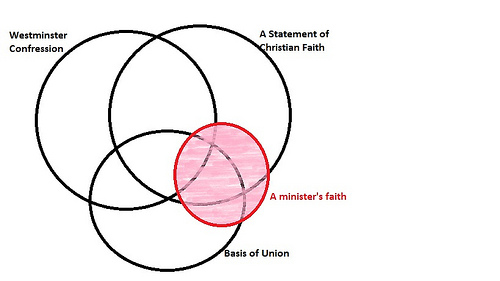
    A while ago I drew two pictures of what we would mean if we required a ministers faith to be in substantial agreement with the subordinate standards. I suggested the URC’s approach was like the diagram shown here. I would suspect quite a overlap with the Basis of Union, maybe with quite a bit of agnosticism about parts of it, with other bits being inconcurrence with other Subordinate Standards which we accept. In other words the tradition is defined by having a broad scope with many overlapping subordinate standards and the requirement is that the faith falls mainly within those parameters. It does not mean that all ministers sign up to the same things exactly. Indeed although I have shown three here, there are at least another six named subordinate standards. I defy anyone to know them well enough that they can recall them at an instance and say what they agree and disagree with them let alone accept them all. Then there are the ones we don’t name but are included as “of the tradition” e.g. the Scots Confession. However what status is John Robinsons address to the Pilgrim Fathers at Plymouth.  You won’t find it on the internet, I might put it up at some stage if I get hold of it, but the paraphrase in the form of We limit not the Truth of God (ignore the tune) is widely sung in the URC and I have heard quoted in theological debate. There is thus a deliberate ambiguity.

    Yes I use the subordinate standards, they have been an important vehicle of my initiation into Reformed Theology, but I do not use them in a sort of lets try to believe twenty impossible things before breakfast style. I usually read them through quite quickly the first time, to try to get a feel of them, what is important and how they stand. Then and this is an ongoing process I turn to bits I see as significant and try and work out why. It maybe I disagree with them, in which case I need to work out why, or it might be a phrase gives me cause for reflection, time to look deeper at other understandings. So Subordinate standards are there to say where we have been, not to determine who we are. Remember “Those who cannot remember the past are condemned to repeat it” (George Sanayana) so we need methods of remembering where we have been and knowing why we have travelled to where we are.

    When two traditions collide

    In 1972 the URC came into being and two denominational traditions collided. There are problems today that are caused not by the positions regarding wider traditions, these were both traditions dominated by the Reformed Tradition, but by the fact that the two traditions did not bother to find out how the other tradition worked, the Presbyterian assumed that with these sort of half toned Congregationalists they would find it easy to dominate, the Congregationalists assumed that they would continue doing things as they always did with a few adjustments for Presbyterians as they had done before. The Presbyterians assumed there was a meeting two dissenting traditions of which theirs was superior  because it was articulated. The Congregationalists just assumed the way they did things was the way it was to be done noy because it was Congregational but because that was how it was.

    The mistake was made in thinking that within English Congretationalism there was a named tradition that in some way is comparable to the Presbyterian tradition of the Presbyterian Church of England. This Presbyterian tradition is that of a clear dissenting tradition that stands against the mainstream. It says “We do this BECAUSE we are PRESBYTERIAN”. It is clear and defined. English Congregationalism on the whole found no need for such a tradition. Indeed may have found problems with having it. Rather with respect to tradition it relates as a dominant discourse, the tradition has no name (or rarely is named) but is referenced by how “We do it”.

    I suspect that this has several roots. Firstly the obvious one, the tradition is not a single strand but a loosely woven rope of many strands that are not always compatible. It is true that the Reformed strand is the core one but there are plenty of other bits. It has to be seen as an grouping that specialises in bringing the disparate together. What is more with the Independent part, for most congregations “the tradition” is primarily the tradition of that congregation and only secondarily draws on the wider experience of other congregations and the wider church. When you talk about the wider context few members have any interest. Thus there is a need to have a way of talking and holding things together without setting people’s backs up. Names tend to carry baggage with them, so it is convenient if their is no name for anyone to object to.

    Secondly in England there was an indicator name change I suspect at the end of the nineteenth Century. Before that all Congregational churches tended to be called Independent and Congregational used only after then. Traditions are conservative by nature, I suspect that there is a strong streek of people who still think of themselves as going to the Independent Chapel despite this. To add to this the change seems to coincide with the NonConformist Ascendancy in Late Victorian times. There were places in England where Congregationalism was the dominant tradition, so naturally it took the dominant form.

    The result is that former English Congregationalists are not concious of their Congregational heritage but they are secure in it, assuming it is the way things ought to be done by any rational person. They have not had a name and feel no need for a name. For them the question was how the Presbyterians will alter the way we do things. It is a tradition based around absorbing not fracturing.

    The former Presbyterians, as do former Congregational Church of Scotland, (I have not idea what former Churches of Christ do) find that what happens is that instead of their nice named dissenting tradition, they are faced with a nameless mesh of ideas that somehow resists their attempts to say what it should be like.  What is worse it uses the first person plural “We” of itself so your choice is to join it or dissent from belonging. This is not tradition as they know it, yet it assumes the dominant position.

    Respect the Culture of the Internet

    An incident still annoys me and it is probably ten years since it happened. I was studying Sociology and doing one of the how to courses, which had its bit on ethics and the need to anonymise. One guy did a bit on exploring internet culture and the thing that rankles is that he totally disregarded this advice, so much so I am sure I know and can get in touch with one of his informants.

    He took a bit of conversation from a chat room. It was a short exchange between two people using nom de plumes. It looked to him as if people were using pen names and therefore he thought he did not need to anonymise. What is more the name was short and not a recognaisable name in any language. Surely this name was not a give-away. It is, it belongs to one specific person who has used it for the best part of twenty years or more. If I see that name anywhere on the internet I assume it is her who typed that. What is more the personna she portrays in the interaction is typical of her personna elsewhere where I do know her.

    Lets go back to the beginning and to usenet boards and maybe even earlier. Names were limited, the maximum length was eight characters if you were lucky. So you could not have JohnSmith as your name. The challenge in those days was to find an eight letter code that was both memorable and not taken. Once found people tended to stick with it. In a very real sense they developed an ownership of that code. Towards the end of those days a six letters in a search engine would have got you most of my internet activity except work stuff (there it was five). Now you’d have to go down half a page to find something that relates to me as others use that code. However some have stuck with their name or code and some of those are very short.Therefore when people move from forum to forum you can look out for the same names and find the same people.

    So despite what the social scientists like to think, the internet was never a lot of nameless geeks rampaging around having careless fun. The geeks from fairly early on established a culture that maintained identity across bulletin boards, message boards and discussion rooms. There was no policing except the more codes you used the more names and codes you had to do, sock puppetry (having multiple codes on a single discussion board, was looked down upon). In a stuation where discussion boards appeared and disappeared pretty frequently by doing so people often knew who they were talking to or at least knew what previous interaction they could recall.

    Now with something like twenty years of being on the internet (alright so I was technically on one of its precursors in 1984 and I have very rarely been off since but using really started around 1992 with the present job). I can say that on the internet it is possible to fool everyone sometimes and some people all the time but it isn’t possible to fool everyone all the time. It is simply too much effort for most people to keep two or more different consistent personas going. They normally make one of two mistakes:

    1. The actually create two very similar personnas, and then some adminy type does the checking on the logs and all are revealled
    2. The go for the spectacular, with heightened stories or crusading for a particular perspective (Kierkegaard the first internet troll?). These draw attention, almost certainly as much suspicious attention as any others. Such people are either unmasked or are asked to leave as they are causing problems.

    To do it successfully you must keep a low key, everyday persona who is distinct from yourself for long periods of time. Its not easy, imagine trying to write fiction that is as boring to yourself as paint drying and you get some idea of what they have to do. My suspicion is the vast majority of people who try that get bored. What is the point of being , clever if no-one knows about it and if anyone knows then your game is up and you are no longer clever.

    So when you investigate social behaviour on the internet, please do not fall for the simplistic assumption that pen-names are anonymous. They may be or they may be the way that individual is most widely known.

    Fair Fuel: fair to whom?

    I am begining to wonder if some people understand what joined up thinking is. Low tax on fuel may not be a good idea and here is why:

    1. Oil is a limited resource, the consensus is that we are over dependent on it in the west and if the oil producing countries suddenly stop producing oil for some reason our own supplies are even more limited. We are an oil consuming; while not really an oil producing nation, Europe’s supplies are due to run out in two years and I suspect most of those are in Eastern Europe. Some oil producing countries are very volatile politically. So long term oil will run out, short term we are rather dependent on friends where perhaps we would be wise not to be. So anything that means we should use less, being more cautious about what we use may be for our own long term health. What is more my Chemistry teacher argued that oil is such a valuable substance it should not just be burnt up and that goes back to 1980s. It seems to me it is pay now or pay more later.
    2. You have heard of global warming, the theory suggests that to some extent it is related to increase in carbon dioxide in the atmosphere. The bi-product of burning oil in a combustion engine is carbon dioxide which is put out into the atmosphere. Given the effects that can cause I suspect we should be trying to minimize rather than increase the risk for the sake of the whole planet.
    3. Finally we will talk about how high oil prices makes UK industry uncompetitive with other industry. Keeping oil prices relatively low in the developed world has often been a method of enabling UK industry to out compete local industry in third world countries, sometimes the need to do this had led to quite drastic situations such as Ogoniland Oil Spill

    Need I point out that if paying more for our petrol, food and other goods now, weans us off our culturally high dependency on it, it may well be good for the whole planet. It seems to me that much of the present outcry is about preserving our present lifestyle at the expense of the poor and the future. Some how that seems selfish.